
Hubble Telescope Paves the Way for Roman Space Telescope Research Using Gravitational Lensing
22.10.2026, 20:21·
COLLECTED AND VERIFIED AUTOMATICALLY
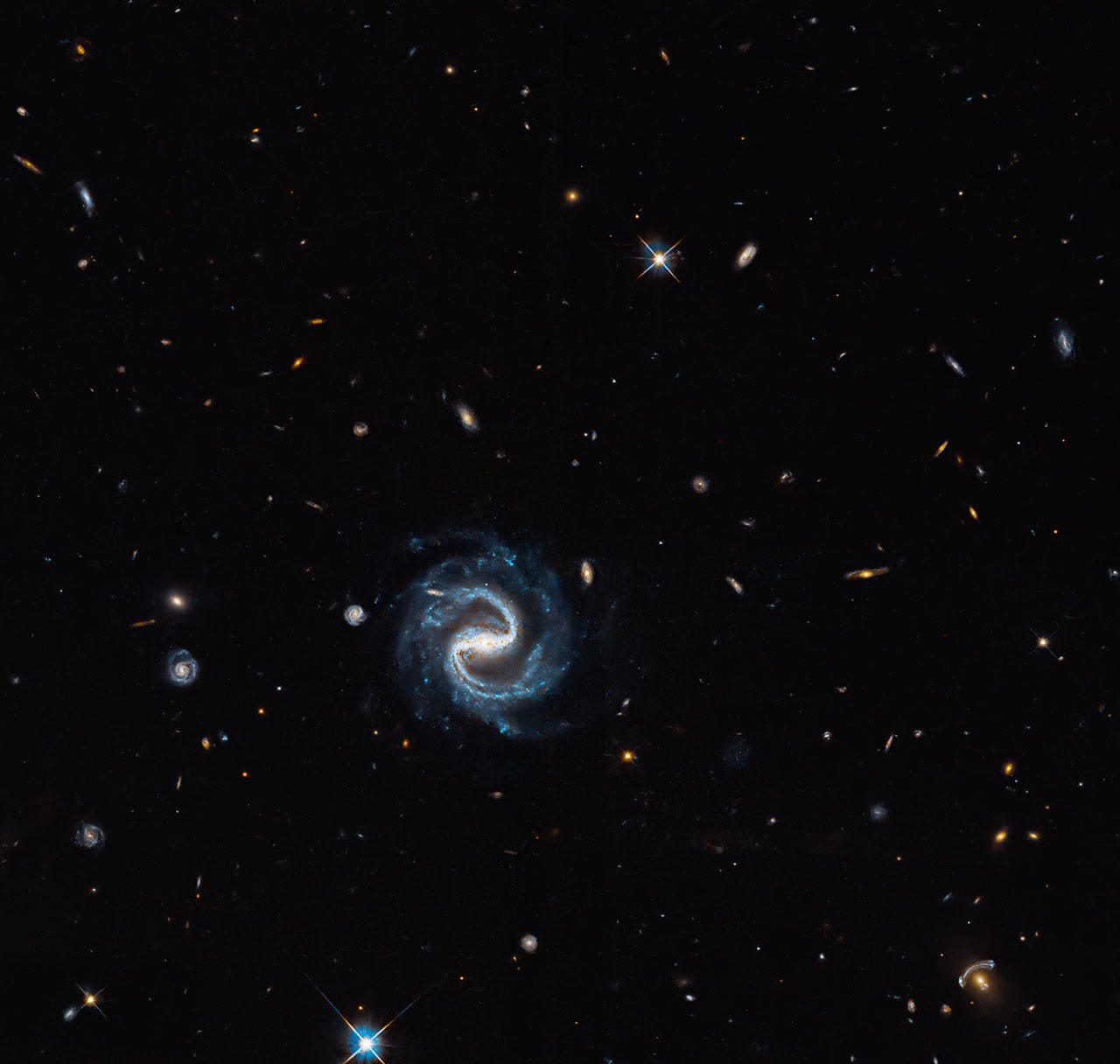
The Hubble Space Telescope continues to obtain images of gravitational lensing — an effect in which massive objects, such as galaxy clusters, curve spacetime and distort light from more distant objects, creating arcs and rings around the lensing bodies. This phenomenon allows astronomers to study the distribution of dark matter and observe distant galaxies that would otherwise be too faint to detect.
The image presented by NASA is one of a series of similar images that Hubble is capturing in preparation for the new Nancy Grace Roman Space Telescope. The data obtained will help scientists pre-identify promising areas of sky for study and optimize the scientific program for the future mission.
The Roman Space Telescope, expected to launch in the coming years, will have a significantly wider field of view compared to Hubble, enabling large-scale sky surveys and detecting far more examples of gravitational lensing. This, in turn, will expand the possibilities for studying the evolution of the universe, the distribution of dark matter, and the properties of distant galaxies.
Such preparatory observations demonstrate continuity between NASA's space missions: data collected by one telescope is used to plan and enhance the efficiency of the next generation of instruments. The Nancy Grace Roman Space Telescope project is considered one of the key directions for NASA's space astronomy development in the coming decade.
This article was generated and published automatically from verified sources. If you spot an inaccuracy, it will be corrected on the pipeline's next pass.