
Hubble Telescope Captures Spiral Galaxy and Gravitational Lens
29.10.2026, 17:26·
COLLECTED AND VERIFIED AUTOMATICALLY
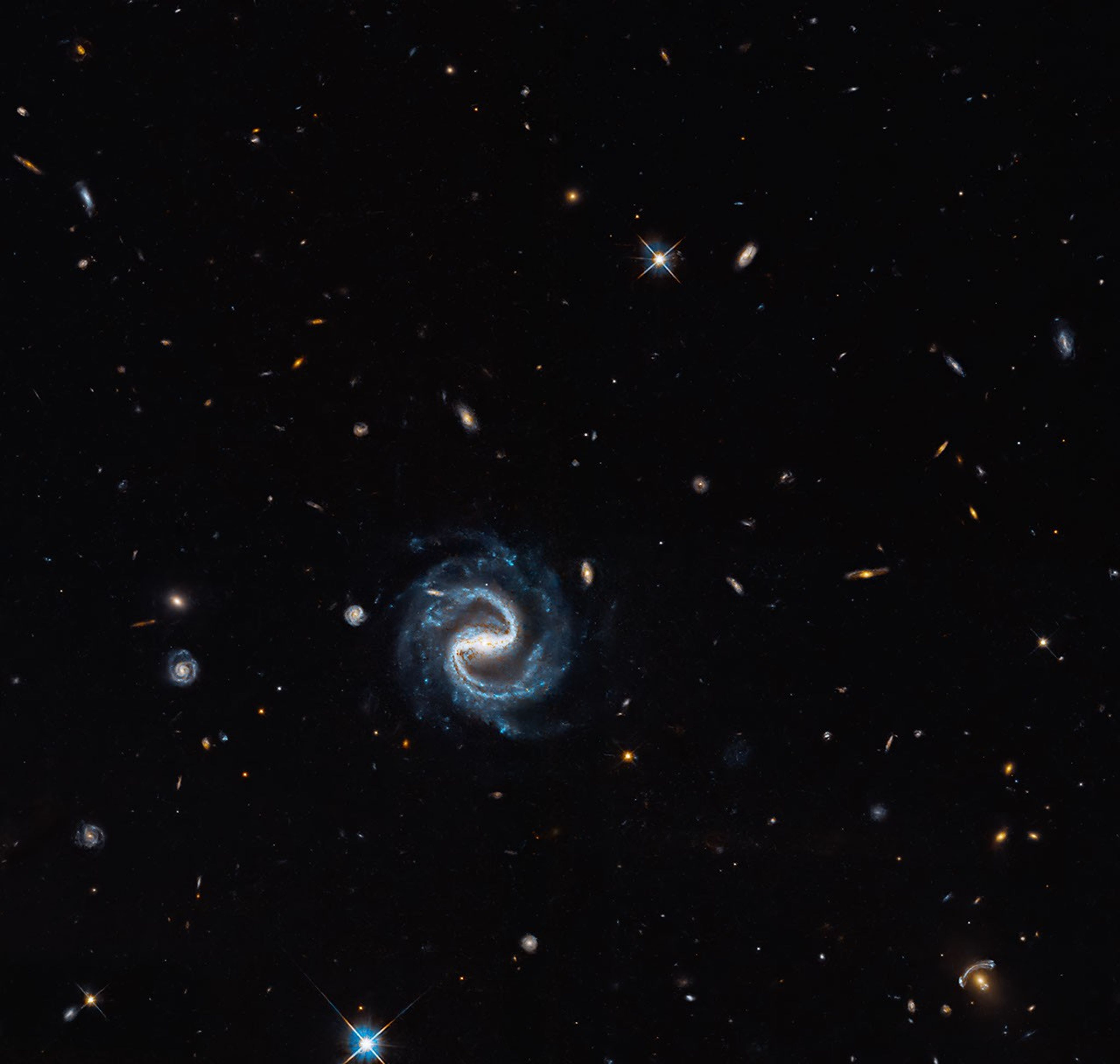
NASA's Hubble Space Telescope has obtained a new image in which two fascinating astronomical objects appear in the same field of view: a winding spiral galaxy at the center of the frame and a bright gravitational lens at the edge of the image. Gravitational lensing is an effect in which a massive object, such as a galaxy cluster, curves spacetime so strongly that light from more distant objects, passing nearby, bends and distorts, creating characteristic arc-shaped images.
Such observations help astronomers study the distribution of mass throughout the universe, including invisible dark matter, as well as peer into the most remote regions of space that are inaccessible to direct observation. The image was taken as part of a program that paves the way for a future mission—the Nancy Grace Roman Space Telescope, whose launch is planned for the coming years.
The Roman Telescope will be a successor to and complement for Hubble and James Webb, offering a significantly wider field of view while maintaining high image clarity. This will enable scientists to conduct large-scale sky surveys, discover thousands of new gravitational lenses, and study galaxy evolution at different stages in the history of the universe. Data collected by Hubble today helps identify promising observational areas in advance and develop analysis methods that will subsequently be applied when working with the Roman Telescope.
Such collaborative efforts by multiple generations of space observatories allow NASA to progressively expand knowledge of the structure and history of the cosmos, laying the groundwork for new scientific discoveries.
This article was generated and published automatically from verified sources. If you spot an inaccuracy, it will be corrected on the pipeline's next pass.