
James Webb Telescope Captures Image of the 'Cat's Head' Nebula
30.10.2026, 18:29·
COLLECTED AND VERIFIED AUTOMATICALLY
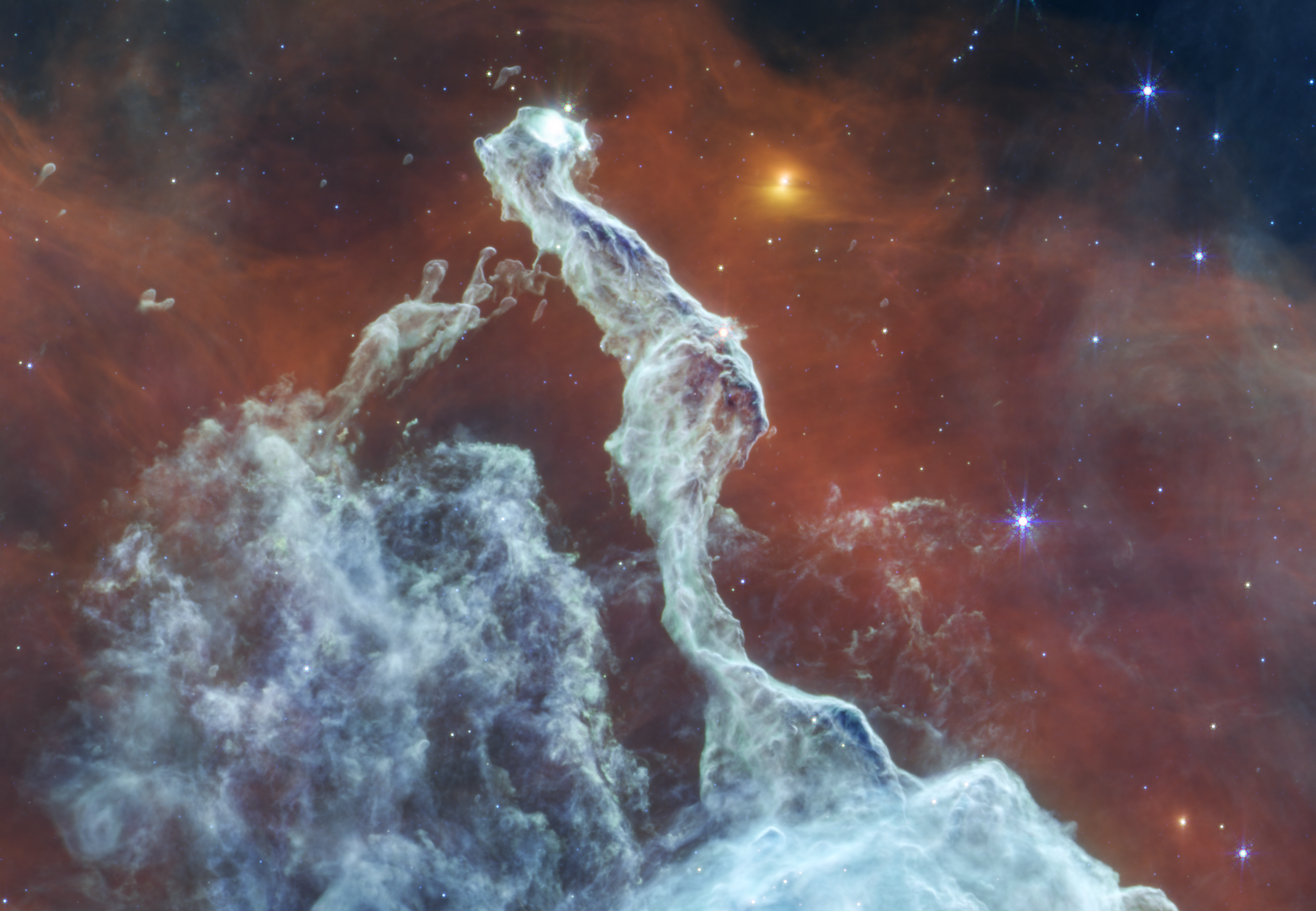
The National Aeronautics and Space Administration (NASA) presented a new image obtained by the James Webb Space Telescope on October 29, 2026. The image, captured in the mid-infrared spectrum, reveals complex structures within a nebula whose shape resembles a cat's head.
According to scientists, the characteristic contours of the object, which has been informally named the 'Cat's Head,' were formed over an extended period under the influence of powerful ultraviolet radiation and stellar winds from massive stars located within the Carina Nebula. This stellar radiation gradually acted upon the surrounding gas and dust, shaping the peculiar outlines that observers compare to an animal's face.
The Carina Nebula is one of the largest and brightest diffuse nebulae in our galaxy, known for its active star-forming regions and extreme astrophysical processes. Observations by the James Webb telescope, equipped with instruments for infrared observations, allow scientists to peer through dense clouds of cosmic dust and obtain detailed information about the internal structure of such objects, which is inaccessible to optical telescopes.
The new image adds to a series of stunning pictures that the James Webb telescope has been regularly transmitting since the beginning of its scientific mission, continuing to expand humanity's knowledge of star formation processes and the evolution of the interstellar medium.
This article was generated and published automatically from verified sources. If you spot an inaccuracy, it will be corrected on the pipeline's next pass.