
Hubble Telescope Detects Oxygen Shortage in Nearby Dwarf Galaxies
02.11.2026, 18:09·
COLLECTED AND VERIFIED AUTOMATICALLY
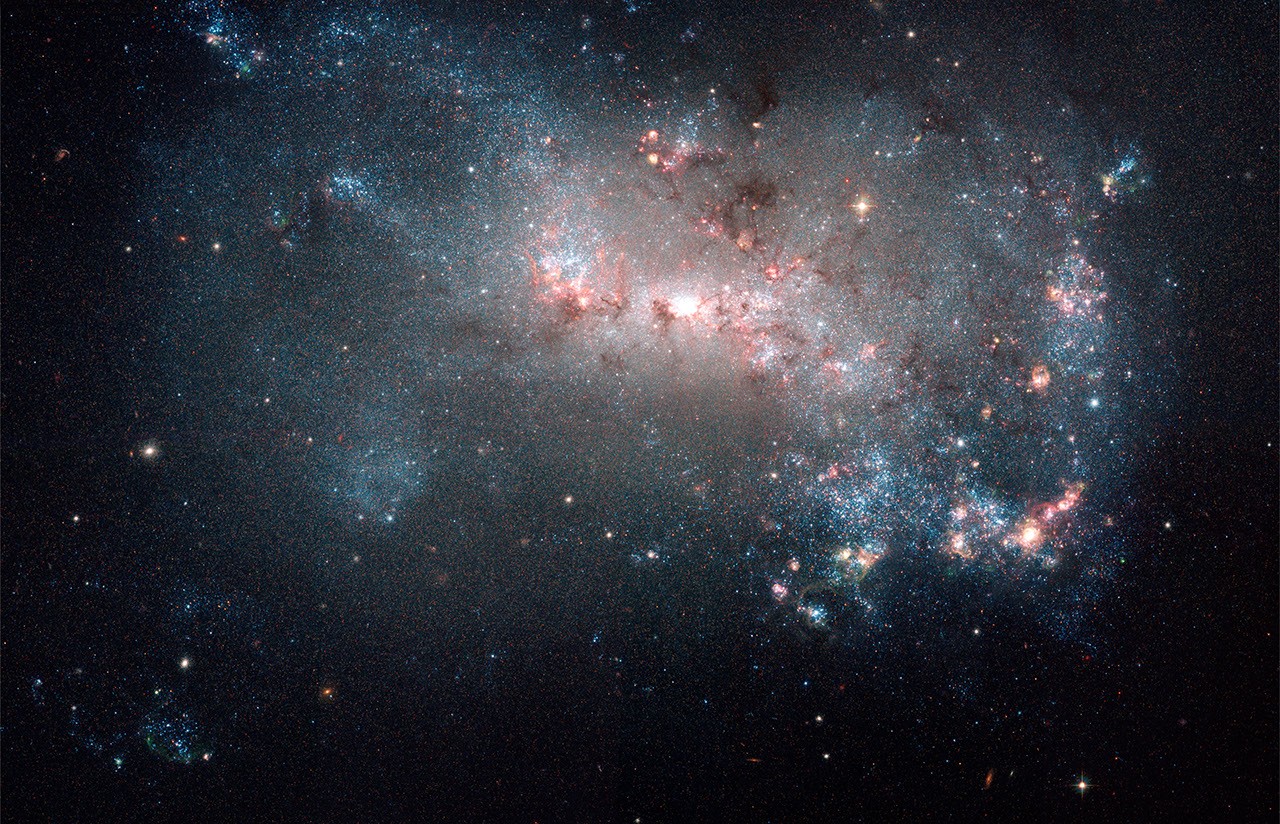
NASA's Hubble telescope conducted a study of 37 dwarf galaxies located near the Milky Way and found an unexpected oxygen deficit. According to existing models of stellar evolution, these galaxies should have accumulated significantly more of this element as a result of star formation processes and subsequent supernova explosions, which typically enrich the interstellar medium with heavy elements.
However, observations showed that the actual amount of oxygen in the studied galaxies is noticeably lower than predicted. Scientists suggest several possible explanations for this phenomenon: oxygen may be leaving the galaxies along with powerful stellar winds and matter ejections, or it may exist in a different, hard-to-detect form — for example, as cold gas, which is difficult to register using standard observation methods.
Dwarf galaxies are of particular interest to astronomers because they are considered among the most primitive and least-changed cosmic structures that have survived since the early Universe. Studying the chemical composition of such objects helps scientists better understand the processes of galaxy formation and evolution in general, as well as the mechanisms of enriching the intergalactic medium with elements necessary for the formation of stars and planets.
Researchers plan to continue observations using Hubble and other instruments to determine the exact cause of the detected anomaly. The results could impact existing theoretical models describing matter circulation in dwarf galaxies and their interaction with the surrounding space.
This article was generated and published automatically from verified sources. If you spot an inaccuracy, it will be corrected on the pipeline's next pass.