
APOD: Sub-ice 'Fishing' for Cosmic Neutrinos
11.10.2026, 08:26·
COLLECTED AND VERIFIED AUTOMATICALLY
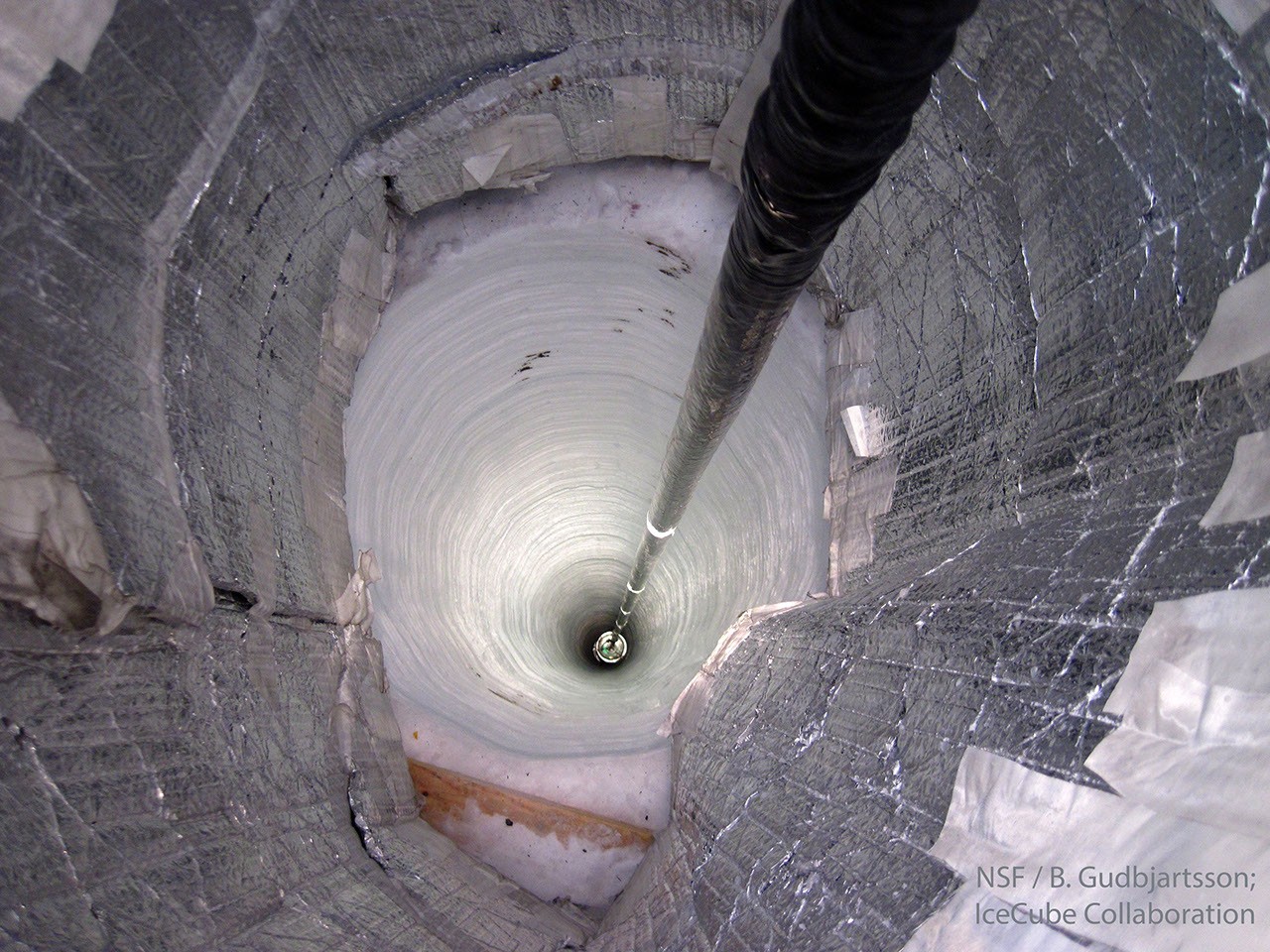
The latest installment of NASA's Astronomy Picture of the Day (APOD) is dedicated to an unusual method of studying the Universe—detecting cosmic neutrinos using Antarctic ice. The featured image illustrates the operation of the IceCube observatory, located at the South Pole, where hundreds of optical sensors are frozen into the ice sheet at depths of up to two and a half kilometers. Neutrinos are extremely light particles that interact weakly with matter, born as a result of powerful cosmic processes, including supernova explosions, black hole activity, and neutron star collisions. Due to their 'elusiveness,' they pass through planets and stars almost unimpeded, making them extremely difficult to detect, yet simultaneously valuable for studying the most extreme phenomena in the Universe. Antarctic ice serves as a natural detector medium: when a rare neutrino does interact with an ice atom, a Cherenkov radiation flash is produced, which sensitive sensors record. The project authors compare the process to sub-ice fishing—scientists 'cast' an enormous icy 'net' in anticipation of rare 'catch' in the form of a particle traveling from the depths of space. Like other APOD releases, the publication is accompanied by a brief explanation from a professional astronomer, discussing the astrophysical significance of the observations. The IceCube project allows researchers to glimpse into the processes occurring in the most remote and energetically powerful corners of the Universe, expanding our understanding of the nature of cosmic rays and extreme astrophysical events.
This article was generated and published automatically from verified sources. If you spot an inaccuracy, it will be corrected on the pipeline's next pass.