
Mars and the Beehive Cluster Against the Aurora Borealis Over Sweden
14.10.2026, 08:21·
COLLECTED AND VERIFIED AUTOMATICALLY
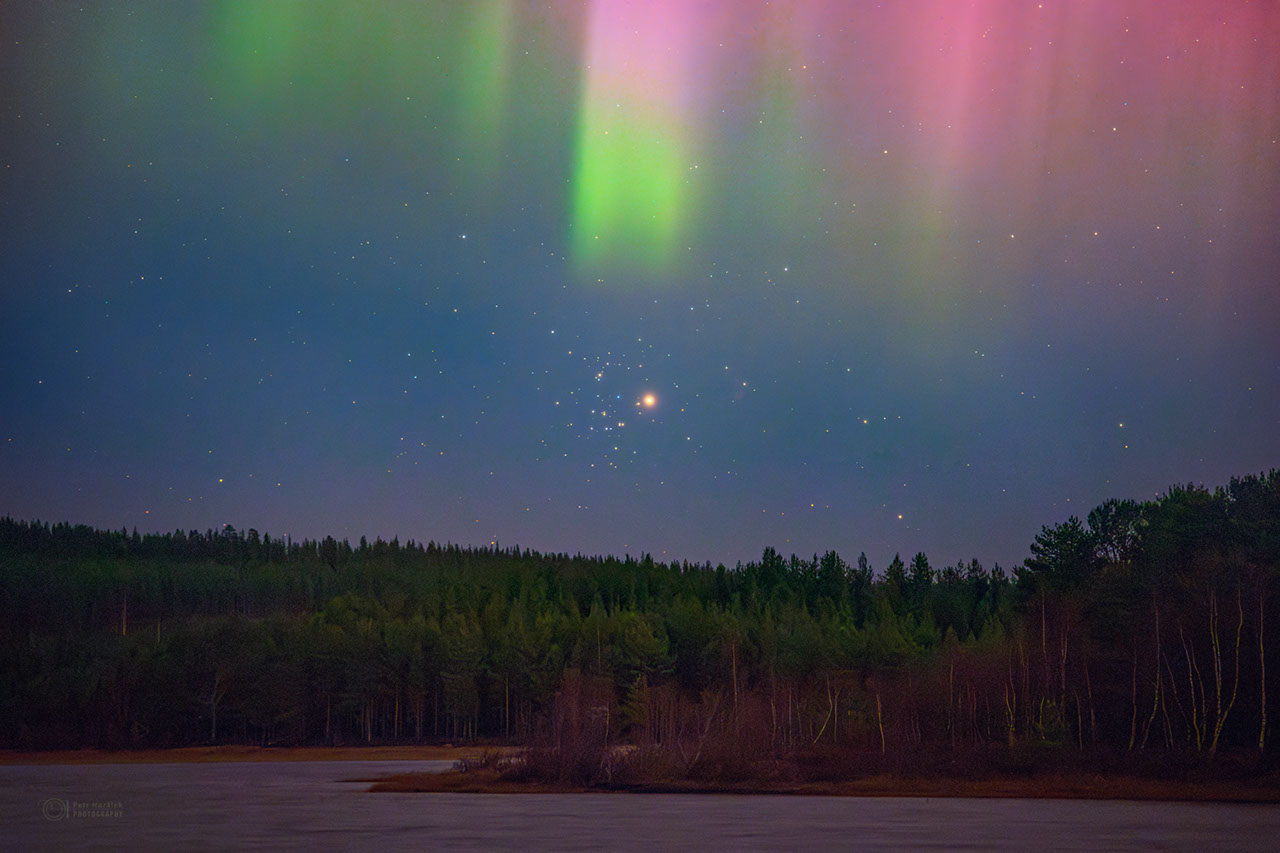
In a new photograph published as part of NASA's Astronomy Picture of the Day (APOD) project, an unusual combination of astronomical phenomena has been captured. The image shows the planet Mars positioned next to the Beehive star cluster (M44), situated directly beneath the shimmering curtains of the aurora borealis. The composition is complemented by an earthly landscape—silhouettes of trees on the horizon near the village of Lansjarvi in northern Sweden.
The Beehive Cluster is an open star cluster located in the constellation Cancer and contains approximately a thousand stars. It is clearly visible to the naked eye in dark skies and is one of the nearest such objects to Earth. The alignment of Mars with the cluster creates a striking visual composition that highlights the motion of planets across the celestial sphere relative to the fixed stars.
The aurora borealis, which serves as the backdrop for this celestial display, arises from the interaction of charged particles from the solar wind with Earth's magnetic field and atmosphere. Northern latitudes, including northern Sweden, are traditionally among the best locations for observing this phenomenon due to their proximity to the Arctic Circle.
The photograph demonstrates how a rare combination of astronomical and geophysical phenomena can be captured in a single frame, reminding us of the beauty and complexity of processes occurring both in Earth's atmosphere and in the depths of space.
This article was generated and published automatically from verified sources. If you spot an inaccuracy, it will be corrected on the pipeline's next pass.