
Hubble and Webb Telescopes Photograph the 'Cat's Head' Nebula in the Constellation Carina
29.10.2026, 17:05·
COLLECTED AND VERIFIED AUTOMATICALLY
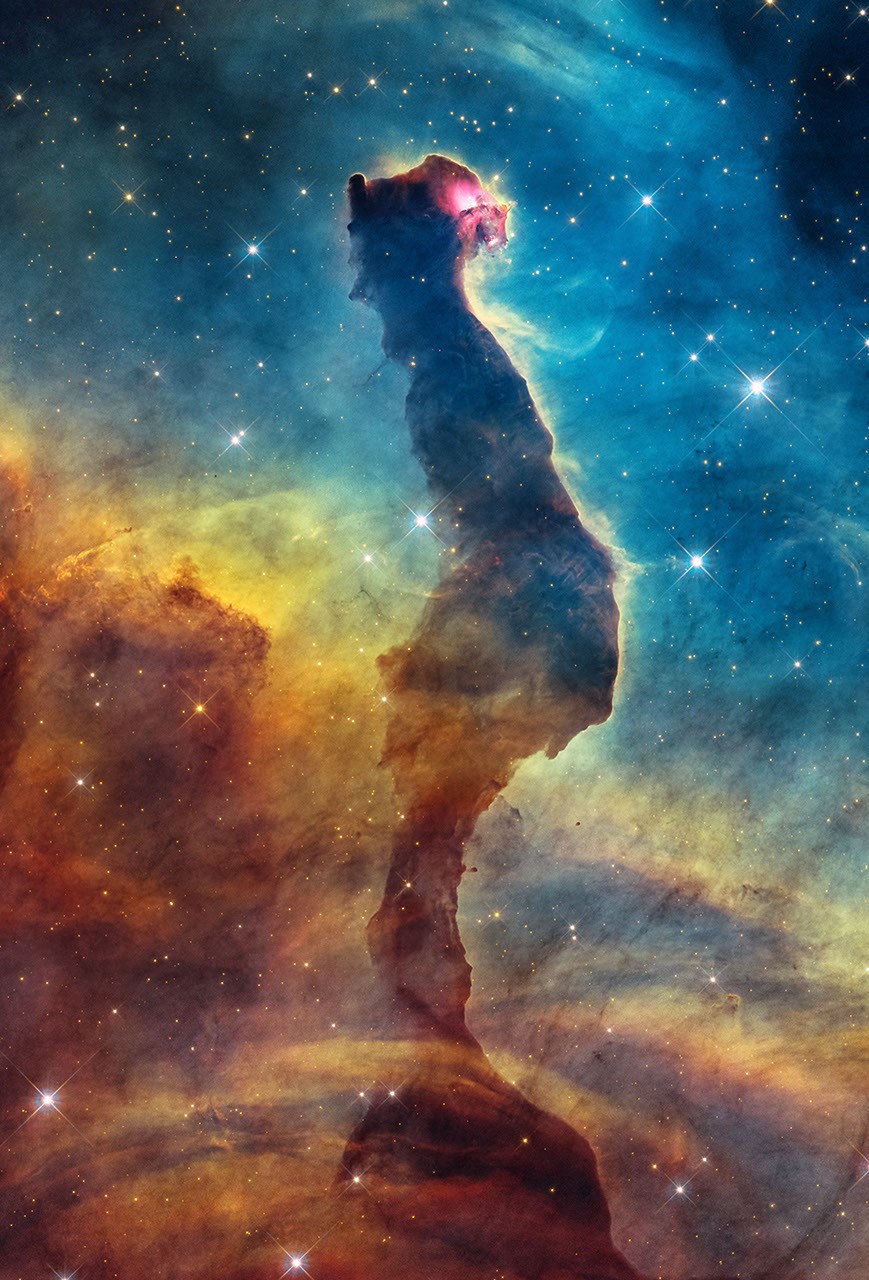
NASA's space telescopes Hubble and James Webb have captured a stunning region of active star formation located within the Carina Nebula—a vast region approximately 7,500 light-years away from Earth. The small area observed by both telescopes has been given the unofficial name 'Cat's Head Nebula' because of its outline, which resembles the silhouette of a feline face emerging through clouds of cosmic gas and dust.
Joint observations by Hubble and Webb provide a more complete picture of the processes at work: the optical Hubble telescope captures visible light and reveals the structure of gas clouds, while the infrared Webb is able to peer through dense dust veils and identify young stars hidden within them. Through such a combination of data, scientists can study in greater detail the mechanisms of star formation in turbulent, substance-rich regions of space.
The Carina Nebula is known as one of the largest and brightest diffuse nebulae in our galaxy, where the birth of many massive stars takes place. Such images help astronomers understand how exactly gravitational and radiation processes influence the formation of new stellar systems, as well as shed light on the dynamics of interstellar matter under extreme conditions.
The publication of new images once again demonstrates the capabilities of the joint work of NASA's two flagship telescopes, which complement each other and make it possible to obtain unprecedented detailed data about distant corners of the Universe.
This article was generated and published automatically from verified sources. If you spot an inaccuracy, it will be corrected on the pipeline's next pass.