
Hubble Telescope Paving the Way for Roman Telescope Research
29.10.2026, 17:05·
COLLECTED AND VERIFIED AUTOMATICALLY
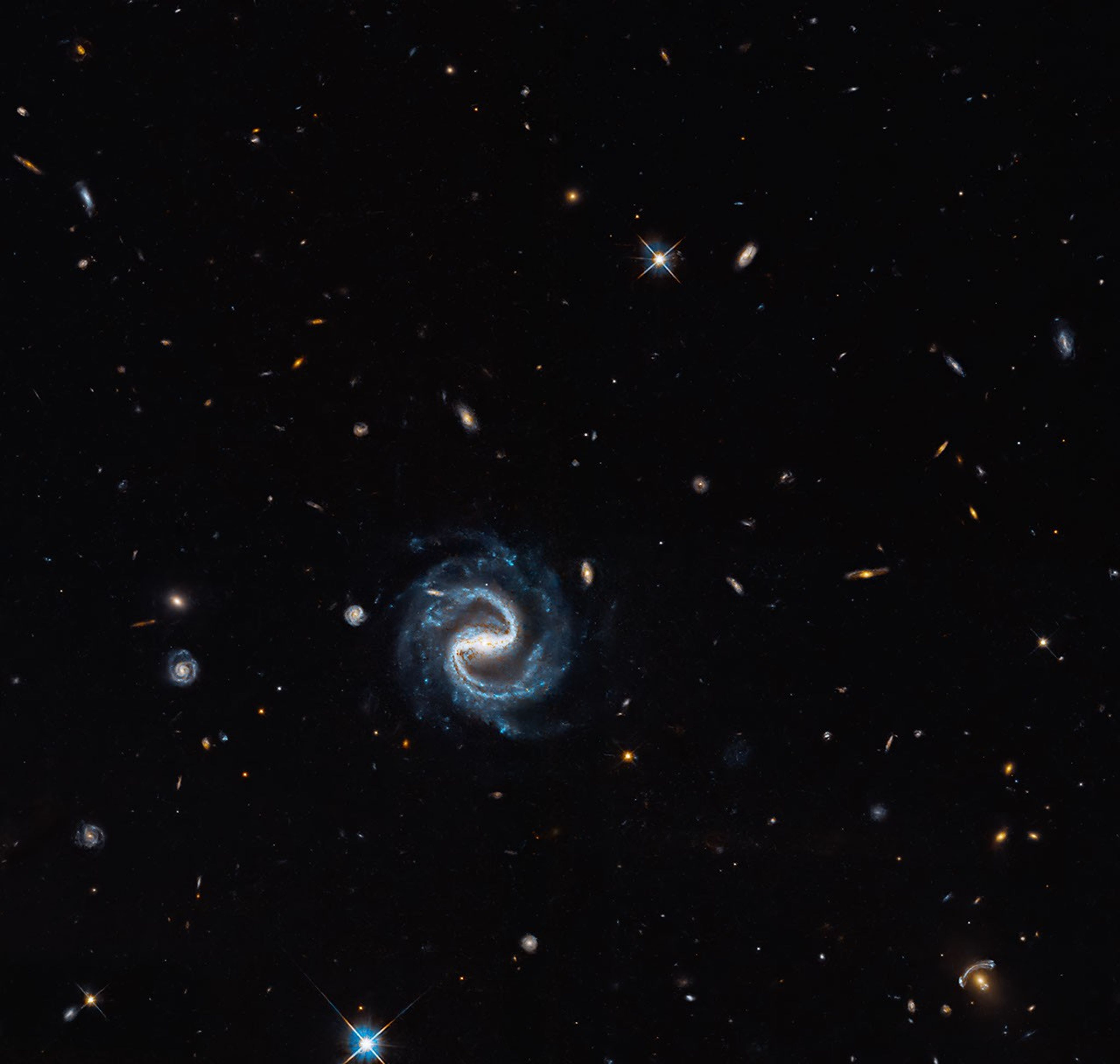
The National Aeronautics and Space Administration (NASA) has released a new image obtained by the Hubble Space Telescope on October 22, 2026. The image depicts a large barred spiral galaxy, but the primary focus of astronomers' interest is the gravitational lensing effect visible in the lower right portion of the image.
Gravitational lensing is a phenomenon in which massive objects, such as galaxies, curve spacetime so dramatically that light from more distant objects passing nearby bends. This creates characteristic arc-shaped or ring-like distortions of distant galaxy images visible from Earth.
This observation is part of a series of gravitational lensing images that the Hubble telescope is collecting as preparation for the scientific work of the new Nancy Grace Roman Space Telescope. Astronomers plan to use the accumulated data to fine-tune future observations with the Roman telescope, which is expected to significantly expand the capabilities for studying the distant cosmos, dark matter, and dark energy.
The Roman telescope, named after NASA's first chief astronomer, will be the agency's next major space observatory instrument. It will possess a wide field of view, allowing for large-scale sky surveys and detecting many instances of gravitational lensing inaccessible to the more specialized Hubble.
Such preparatory observations help scientists identify the most promising sky regions in advance and refine data analysis methodologies, which will accelerate scientific discoveries following the launch of the Roman telescope.
This article was generated and published automatically from verified sources. If you spot an inaccuracy, it will be corrected on the pipeline's next pass.