NASA Presents New Composite Image of the Tarantula Nebula
04.10.2026, 14:54·
COLLECTED AND VERIFIED AUTOMATICALLY
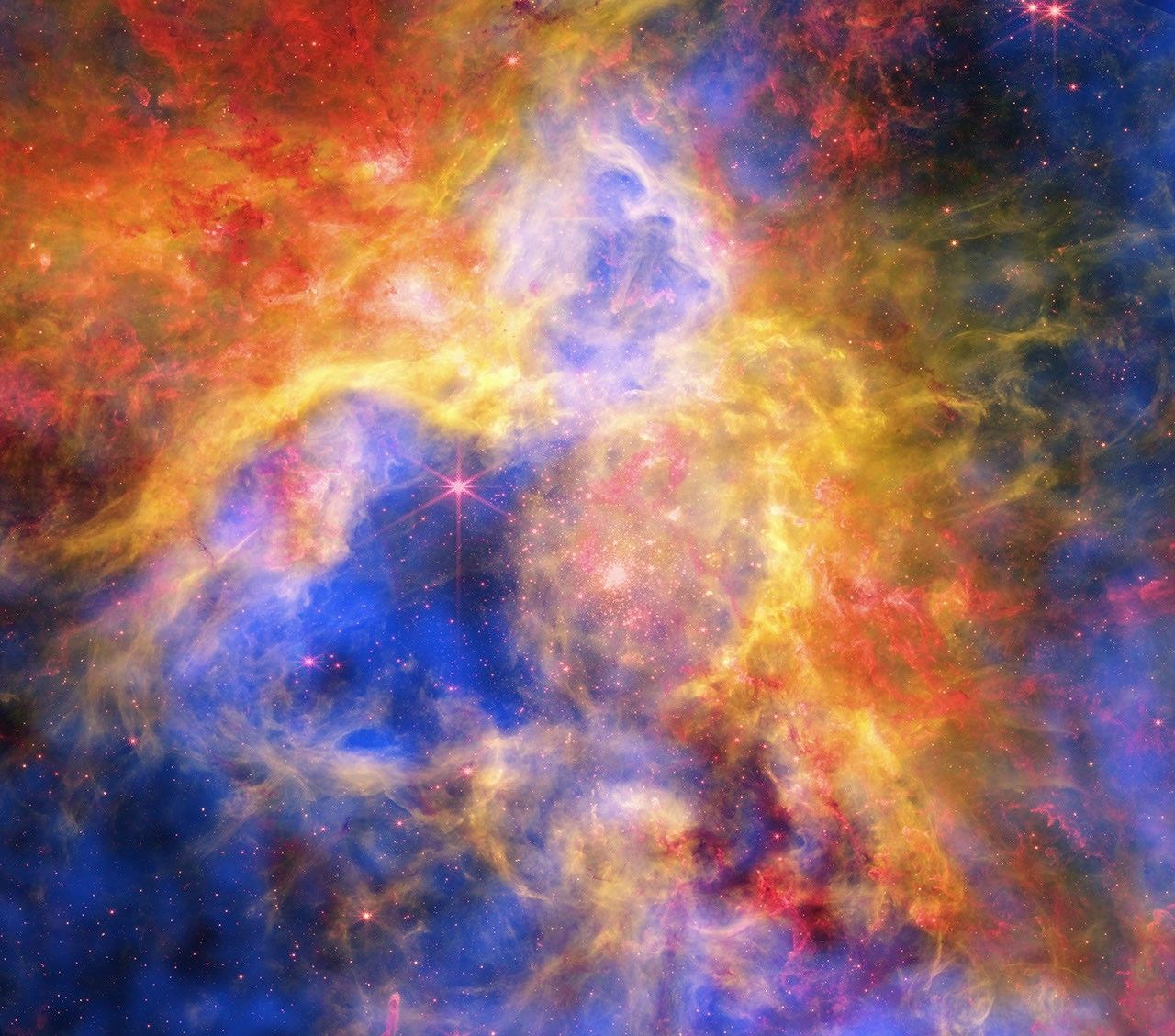
NASA has published a new composite image of the Tarantula Nebula (also known as 30 Doradus)—one of the most active star-forming regions in the nearby Universe. The image was created by overlaying data obtained from various space telescopes of the agency, which made it possible to obtain a multi-layered image resembling a collage of colored cellophane.
Each layer of the image, obtained in different ranges of the electromagnetic spectrum—from infrared to X-ray—reveals different physical processes occurring in the nebula. This approach allows scientists to study the structure of gas and dust clouds, young massive stars, and supernova remnants hidden from observation in visible light.
The Tarantula Nebula is located in the Large Magellanic Cloud—a satellite galaxy of the Milky Way—and is home to some of the most massive known stars. Thanks to its proximity and high luminosity, it serves as an important laboratory for studying star formation processes that also occur in more distant and less accessible galaxies.
The new combined image helps astronomers better understand the dynamics of the interstellar medium, the mechanisms of star cluster formation, and the impact of powerful stellar winds and radiation from young stars on the surrounding gas. Such multi-wavelength observations are a key tool in modern astrophysics, allowing for a complete picture of complex cosmic processes that would be inaccessible using only one type of telescope.
This article was generated and published automatically from verified sources. If you spot an inaccuracy, it will be corrected on the pipeline's next pass.