Hubble Telescope Photographs 'Superbubble' in Nebula N44
04.10.2026, 14:52·
COLLECTED AND VERIFIED AUTOMATICALLY
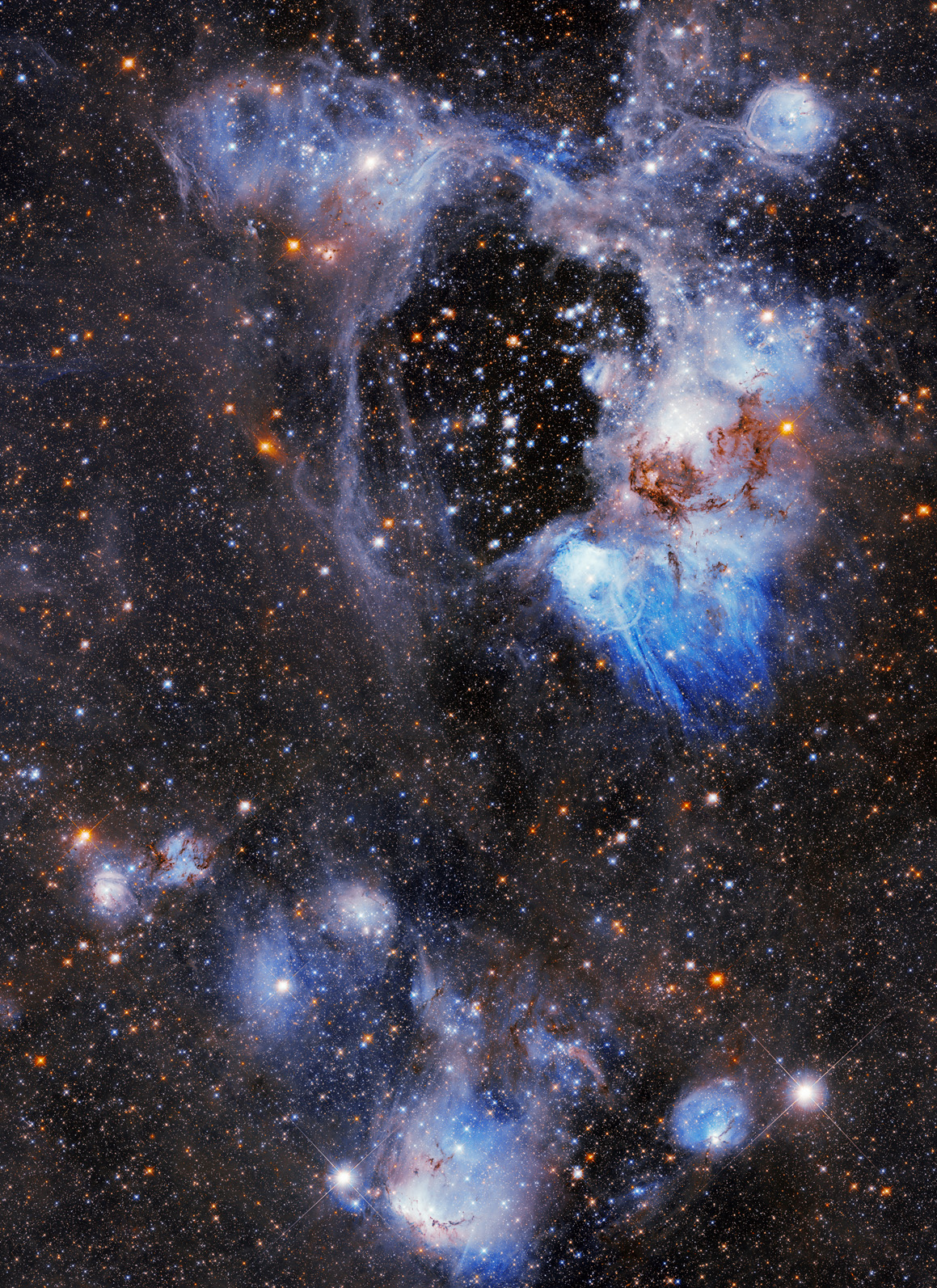
The Hubble Space Telescope has captured a new image of nebula N44, located in the Large Magellanic Cloud — a satellite galaxy of the Milky Way. N44 is a complex structure consisting of glowing hydrogen gas, dark dust bands, and massive stars. Scientists note that the nebula contains multiple generations of stars of different ages, making it a valuable object for studying stellar evolution.
Researchers' special attention has been drawn to the so-called 'superbubble' — a dark region with a relatively small number of stars, visible in the upper central part of the image. Such structures form as a result of powerful stellar winds and supernova explosions, which blow out gas and dust from the central part of the region, creating rarefied cavities of gigantic proportions.
Studying such superbubbles helps astronomers understand the feedback processes between massive stars and the interstellar medium, as well as the mechanisms of new star formation under conditions of intense radiation and stellar winds. The Large Magellanic Cloud, where nebula N44 is located, is one of the nearest satellite galaxies to the Milky Way and frequently serves as a natural laboratory for investigating star formation processes beyond our own galaxy.
The new image obtained with the help of Hubble provides scientists with additional data on the structure and dynamics of the nebula, and also allows them to refine models of superbubble formation in other galaxies.
This article was generated and published automatically from verified sources. If you spot an inaccuracy, it will be corrected on the pipeline's next pass.